about printmaking
The prints I do are not reproductions – but individual pulled prints; either by hand or with a press. There are many types of prints: monotypes, monoprints, intaglio, collagraph, woodblock, linocut, lithography and screen printing. Below are definitions of the ones that you will find in my artwork .
Monotypes. This type of printmaking where there are no permanent marks on the plate. An image is created with ink on a plate by various methods, but only one unique print is created. It is never part of an edition, at most a ghost print may be produced, but it will be labeled as a ghost print which is generally overall lighter in tone.
Monoprints is a name given to a print which has a part of it that can be repeated as another print, but it also has some parts that are like a monotype. Any of the below printmaking techniques can be used, but with added elements. An example of this is relief plate overprinted on a monotype.
Linocuts, Sintracut and Woodcut are relief printmaking; one uses lino, the other wood the plate is carved into creating a design. The surface is rolled with ink and then a print is pulled by hand or with a press. Sintra is a commercial product that not only can be curved like a lino but also can be cut out to make a shape.
Another type of printmaking is Intaglio which can be subdivided into: drypoint, etching, engraving,and mezzotint. Intaglio printmaking uses a press to transfer the ink to paper. An intaglio plate is inked and wiped so that most of the ink sits grooves of the design created on the plate.
Drypoint is drawing is scratched deeply with a metal scriber or a Dremel on acrylic sheeting, polycarbonate sheeting or a copper plate.
Etching uses acid or oxidizing solutions to create textures or lines or tonal areas on the plate. Most often a barrier is applied to protect areas of the plate. The plate is then submerged in the solution which affects the unprotected areas. More areas can be exposed or covered and re dipped in the solution to create tonal differences.
Some intaglio techniques can be combined on one plate. Sometimes more than one plate is used to produce a print and each plate can use a different technique. Variations in inking methods can used. More than one colour can be used, painted on ” a la poupée”. Ink can also be rolled over some or all of the plate; either as a single thin transparent layer or two layers, one thin and one thickened (mixed viscosity rolling).
Collagraph is like an intaglio print and a lino combined. The plate is constructed, most often with matte board, wood or illustration board. The finished plate is much like a bas relief sculpture. It is inked like an intaglio plate and then top surfaces are often rolled .
Tetrapak is a new material used in printmaking. It shares elements of drypoint and collagraph. The Tetrapak plate can be scratched with a scriber or sandpaper and be delaminated in areas exposing the cardboard that absorbs ink. This allows for a large tonal range from complete black in the exposed cardboard to soft light tonal areas made with impressing sandpaper.
Cyanotype is a printmaking/ photogram process. Paper is treated with a chemical solution that is allowed to dry in the dark. It then can be exposed to light using negatives or objects that will block the light wholly or in part from reaching the paper. Once it is exposed it is then rinse and allowed to set and oxidize a deep blue. Other acid and base solutions can be used to alter this colour.
Edition – Prints will have two numbers indicated together. Example 2/10 indicates that that this is the 2nd print of a total edition of 10.
Varied Editions (VE) is when each print has some kind of variation with ink, paper or the addition of chine collé.
AP – Artist proof. This is print that an artist uses to judge the inking of other prints in the same edition. It is the first print pulled after the artist has decided that the plate is ready for printing.
Chine Collé is the addition of pre-printed lightweight paper that is glued into the background of the print. This can be japanese papers, comic book images or even made by the artist.
à la poupée is a way of inking etched plates to have multiple colours in the print. The name refers to making little crude “dolls” with stiff fabric used as ink applicators. The ink is then wiped in a very controlled manner to avoid blending the colours. I personally use old oil brushes instead of “poupées”, but the wiping the plate is the same. It is tricky, time consuming but very rewarding.
Why I like printmaking:
- Technically it is fairly challenging
- I get to work with chemistry and a press
- When I work on the plate it removes me from the subject and makes me focus on the artwork – the texture- the tones- the composition because it is an indirect process
- I can not entirely control the process often unexpected things happen during the process.
- There are lots of different techniques, each one produces its own unique look, and they can be combined to produce a huge variety of results
- Once the big work of completing the plate is done – pulling prints is very Zen- it’s very methodical focused work
- When I left up the blankets on the press and turn over the printed paper – it is like a gift -it is very exciting- when I work in group situations- everyone usually gathers for the big reveal
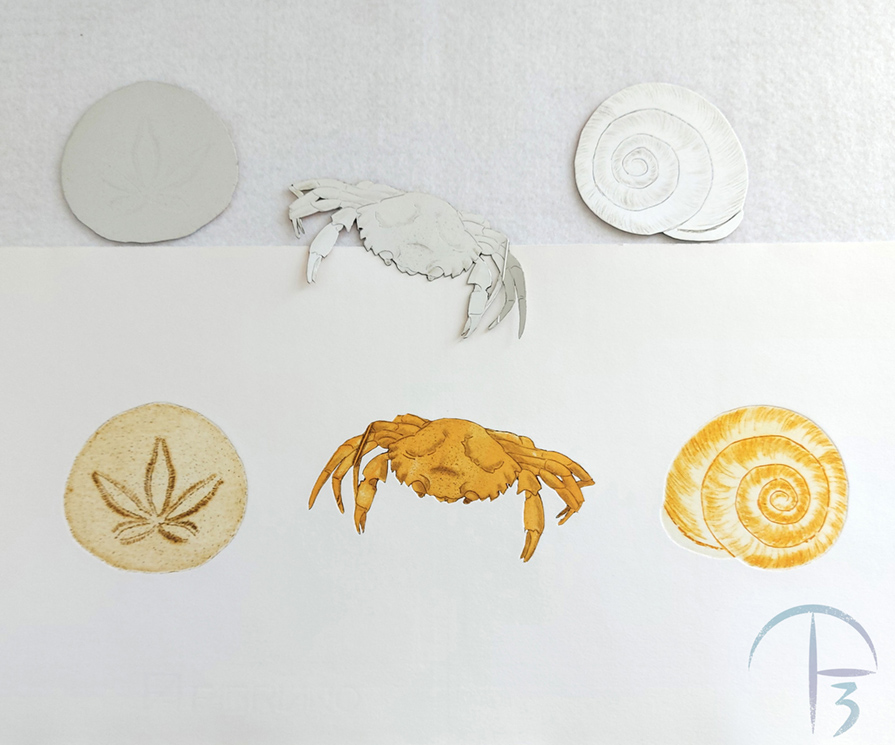
This is an example of 3 Tetrapak plates and the print that was made with them.